NUDGE NUDGE
The virus is the mirror image of our society. It shows us what kind of society we have (...)The virus enters the palliative zone of well-being and turns it into a quarantine zone in which life iscompletely paralyzed into survival.
(Han, 2021: 14)
Let us begin by taking a look at Imperial College London’s description of ‘nudge theory’ that can be found on their website under the category of ‘Nudgeomics’:
A method that has recently come to prominence in the last decade to influence behaviour change is Nudge Theory. The concept was introduced by Richard Thaler and Cass Sunstein in their book: ‘Nudge: Improving Decisions about Health, Wealth, and Happiness’ in 2008.
Nudge Theory is based upon the idea that by shaping the environment, also known as the choice architecture, one can influence the likelihood that one option is chosen over another by individuals. A key factor of Nudge Theory is the ability for an individual to maintain freedom of choice and to feel in control of the decisions they make.
One might ask the glaringly obvious question who decides which options they nudge us towards and what are the ethical implications of this newly emergent discipline?
Foreword
I started writing this essay in 2022 and it has taken quite a few twists and turns since then, one of which was writing a book, or two. The initial motivation for this piece of writing though, emerged from my personal experiences during the C-19 pandemic and its continuing aftermath. I had been bullied and marginalised, coerced and demonised, in a relentless effort to get me to accept that the emperor was actually wearing new clothes and it made me fight back!
I was prepared, because my doctoral research (2015-2019) had interrogated the ways we are psychologically and physically nudged towards moving in a predetermined way in our everyday lives: how we are choreographed in the same way as dance: we can call this choreopolicing. However, my academic work was dense and geared towards a particular audience, the academy. I had to learn a new language, some of it was useful and some of it was designed to obfuscate. The academy demands that you stifle your true voice in order to demonstrate your knowledge, and often the visceral and the poetic are subdued and the gut instinct is unwelcome. The innate instinct and voice of class survival is generally frowned upon in favour of quoting the established voices in the academic field. The legitimised voices you might say. Sometimes you can smell a rat, but you can’t say that!
As a working-class presence in the ‘doctoral’ university space (the first in my family)I found that the perceived ‘course honesty’ of my opinions was often frowned upon, not because I was wrong in my insights but because I was deemed an imposter and my language betrayed an origin that unsettled my colleagues: though not my students.
As an example, at an interview for a funded PhD in performance studies at Leeds University, I was asked what the ‘ontological’ perspective of my inquiry was and how the ‘epistemology’ might be dissected (something along those lines). I had been a successful professional theatre and dance practitioner for three decades, which was supposed to be valued as much as high grades, and I had no idea what they were talking about! I told them that I did not know what those words meant and I was immediately met with condescension and disbelief.
I ended up self-funding my PhD after I was advised by an insider at Bristol University that I was the wrong ‘category’ to succeed in an application: make of that what you will. Fortunately, by not receiving funding or support, I was also free to research without the restrictions of funding constraints that are administrated by governmental politics. It may be that my imposter syndrome was self-inflicted and that I rendered myself ‘less than’?Whatever the case, it has taken me some time and effort to shake off the shackles of academic writing and the language that it employs in order to remain an insider elitist industry.
The Covid Nudge Fest
Since the nudge fest that was the story of the Covid 19 Pandemic, so many pre-meditated scenarios have been thrust our way that I can hardly keep up with examples and the events from which they emerge. It has been overwhelming in its scale and audacity! Now, as we are about to enter 2026, it is time I punctuated my thinking and offered a glimpse into the choreographic state (of affairs) that I am proposing is at play.
I will begin by setting the scene that inspired me to start writing this book way back in 2022, listing just a few of my experiences at the hands of the C-19 authoritarian choreographers.
Border forces continually tried to intimidate me. Corrupt private track and trace companies such as MITIE sent aggressive personnel to my door (on an hourly rate higher than UK nurses) to check that I was isolating in my tiny flat. Some members of the Standing Conference of University Drama Departments forum for academics (SCUDD) sent me anonymous and aggressive mail and PM’s, lecturing me about why I was wrong, and lobbying the SCUUD board to have me removed from the group: after I posted ethics professor Dr Julie Ponesse’s heartfelt statement regarding non-acceptance of her university’s vaccine mandate. The SCUDD forums silencing of discourse was a clear and frightening example of the C-19 ‘groupthink’ that dominated at the time and I was alarmed to think that these dogmatic academics teach young students.
Continuing, I was forced to take dozens of unfit for purpose, intrusive, expensive and physically violent PCR tests whenever I managed to travel or work. It is worth including one of the many silenced expert voices on this subject, and many have emerged since Engelbrecht spoke out on the tests in 2021:
The so-called polymerase chain reaction (PCR) tests, which were claimed to be rock-solid in their ability to detect SARS-CoV-2 infections, were (and still are) without validity and thus worthless in reality. That the so-called SARS-CoV-2 cannot detect such an infection was even confirmed by a Lancet study in mid-November 2020 – and a few days later by a German court.
The list of abuses is long, and I will refrain from charting them all here, but I can say with certainty that they leave echoing traces in my body and mind: a virus of a different sort.
A biosecurity state, where we are advised to follow directives to wash hands, social distance and remember ‘hands, face, place’ is one thing. A legally directed biosecurity state which mandates staying at home is another. We have never before quarantined the healthy and impeded so many human rights in one fell swoop. Our rights to liberty, protest, worship, education and maintaining relationships were all impacted. And these are not trifling privileges, but basic liberties: our human rights as established in law.
(Dodsworth, 2021: 49)
I was living in the UK at the time of the first lockdown announcement and had a six-year-old daughter living in France who I visited regularly and vice versa: I was co-parenting and home schooling her, which is a challenging task at a distance. When the pandemic hysteria hit, I was informed that my daughter and I had to take intrusive and expensive PCR tests, wear masks, obtain special travel papers, and self-isolate, merely to be together. Adding to that, I am a movement director working internationally and suddenly my livelihood had been denied me, as random and nonsensical travel restrictions, often changing daily, were enforced. Individuals with private planes could travel but not me. It just all felt very suspicious and coercive. The suspicion was was confirmed in 2021 when Dodsworth released her revelatory book A State Of Fear. The book contained internal communications that demonstrated the UK governments manipulation of the public psyche:
The perceived level of personal threat needs to be increased among those who are complacent, using hard-hitting and emotional messaging.(Options for increasing adherence to social distancing measures, by the Scientific Pandemic Influenza Group on Behaviour (SPY-B). 22 March 2020.
Dodsworth’s research pointed out that ‘Low-quality evidence in favour of masks was all over the media, but the one decent randomised controlled trial (RCT) into mask wearing was barely reported’. I never wore a mask because the suppressed data clearly exposed them as a performative fiasco and being dangerous for wearers. My personal research denoted that there was little scientific evidence for masks being introduced and that they represented a visual symbol of compliance and fear, a stage prop that signalled, as Dodsworth puts it, that ‘people are dangerous, the world is dangerous and you might feel safer at home’. Additionally, this simple visual prop prompted a level of choreography that was very theatrical in its nature. The unmasked became the Other, an identifiable enemy that garnered aggressive and disproportionate vitriol from the masked. Professor of sociology Stanley Cohen in his seminal work Folk Devils and Moral Panics (2022) describes the conditions that augment the moral panic that is instigated by the conjuring up of the Other:
Societies appear to be subject, every now and then, to periods of moral panic. A condition, episode, person or group of persons emerges to become defined as a threat to societal values and interests; its nature is presented in a stylised and stereotypical fashion by the mass media; the moral barricades are manned by editors, bishops, politicians and other right-thinking people; socially accredited experts pronounce their diagnosis and solutions.
After months of jumping through many, barely accessible, and difficult to locate, administrative hoops, and an interview with a specialist from St Thomas Hospital (specialist in what, I have no idea) I obtained a vaccine exemption certificate (FIG 1). By doing so, I moved further into the realm of the Other.
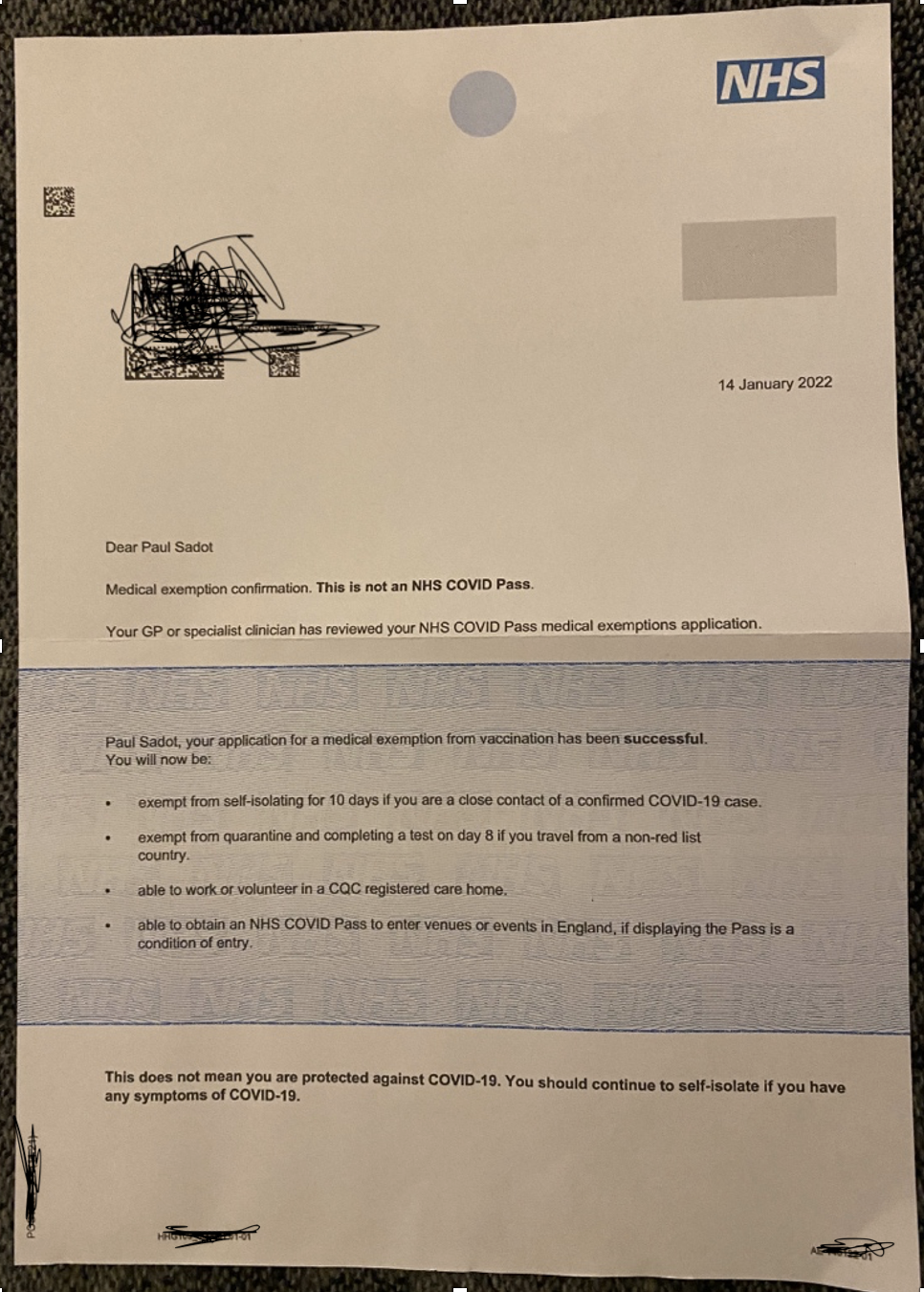
FIG 1
Often, as I showed my certificate to gain entry to trains, planes and spaces, I felt the indignation of those who had chosen to move within the choreopoliced route that was promoted by mass media and government pharmaceutical partnerships. Often, those who were policing the borders had no idea what my NHS exemption certificate was, because - despite the illusion of organised and connected border controls – the rules were being improvised. The border controls were subject to individual choreopolitical interpretations that were narrated through prejudice and fear. On one occasion in Berlin airport, an EasyJet employee attempted to bully me when she saw my vaccine exemption. She was indignant, shocked and personally offended by my exemption status, and demanded that I explain to her why I was not a dangerous bioweapon. I refused because I had made myself aware of my legal rights in each country. She called the police, they agreed with me, and I had to run to get my flight on time. The intimidating draconian staging was put in place in an attempt to contain, restrain and marginalise those who danced freely.
Gustav Le Bon’s 1895 treatise on crowds is an insight into human behaviour that can be applied to these type of hysterical individuals and is as relevant today as it might have been at any moment in history and I will introduce it here and refer to it again at a later point. Le Bon’s book is noted as one of the first studies of crowd behaviour, or what has recently been referred to as ‘mass formation psychosis’ by Mattias Desmet in his insightful book ‘The Psychology of Totalitarianism’. The basic premise is that the individual loses all sense of moral and ethical behaviour when the phenomenon of crowd contagion manifests itself:
Crowds become common property. In the collective mind the intellectual aptitudes of the individuals, and in consequence their individuality, are weakened. The heterogenous is swamped by the homogenous and the unconscious qualities obtain the upper hand
To be clear, I had an exemption certificate, but I also firmly believe in bodily autonomy and freedom of choice, and I support all individuals who fight for their right to choose what goes into their own, or their children’s, bodies. I should not have had to apply for an exemption for something that the UK government and the legacy media were insisting was not mandatory. Following the granting of a certificate that recognised my bodily autonomy, I had to wait weeks for it to appear on my digital records (FIG 2). Yet, in a bizarre twist, the exemption certificate has now disappeared from my records (FIG 3) – though I have screen shots and a hard copy – yet if people are vaccinated for C-19 it remains visible on their medical records. Is some future use implied by this omission and inclusion? To a cynical eye it might be suggested that the government wanted to erase all traces of the ridiculous draconian system they had haphazardly put in place for anyone who wanted to exercise freedom of choice. Whatever the case may be, I was forced to follow their choreographed route in order to move and travel.
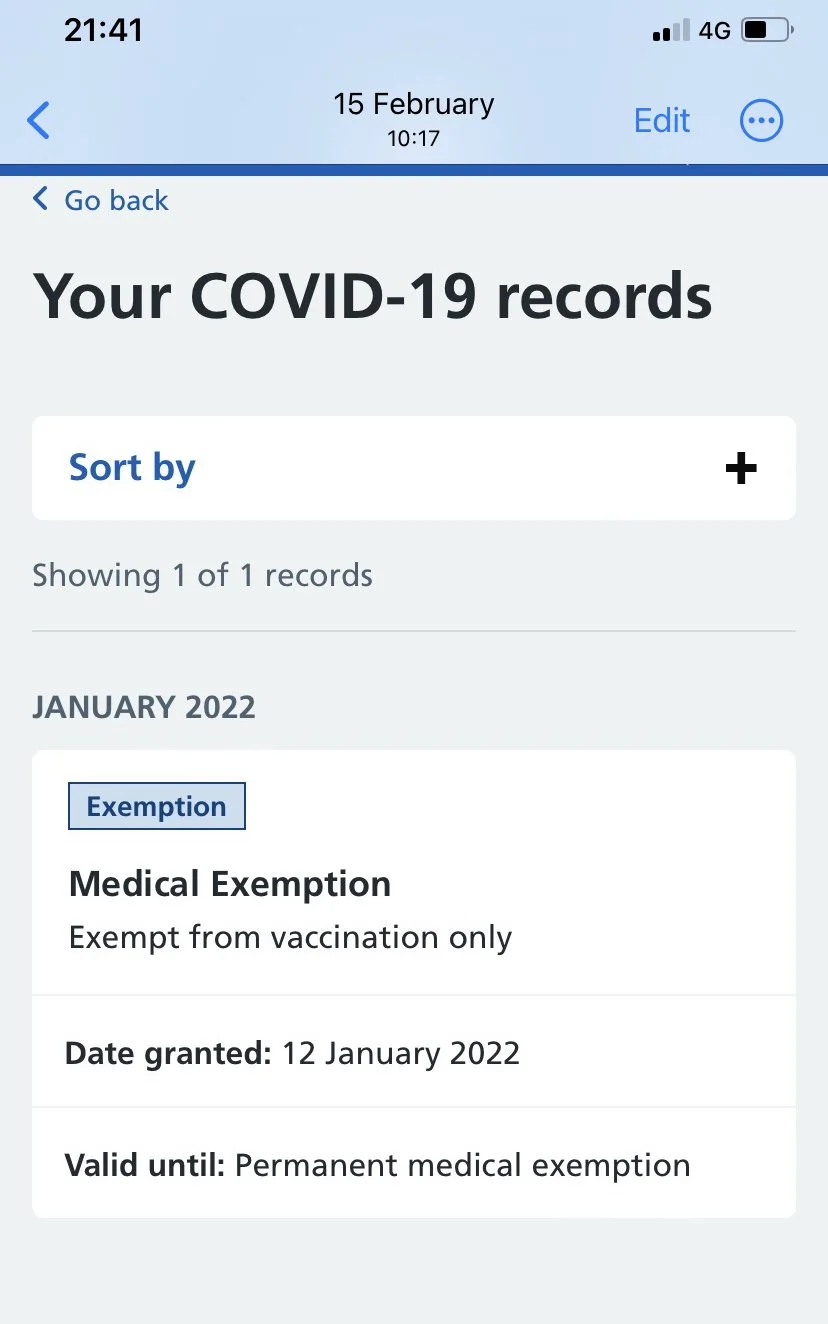
FIG 2
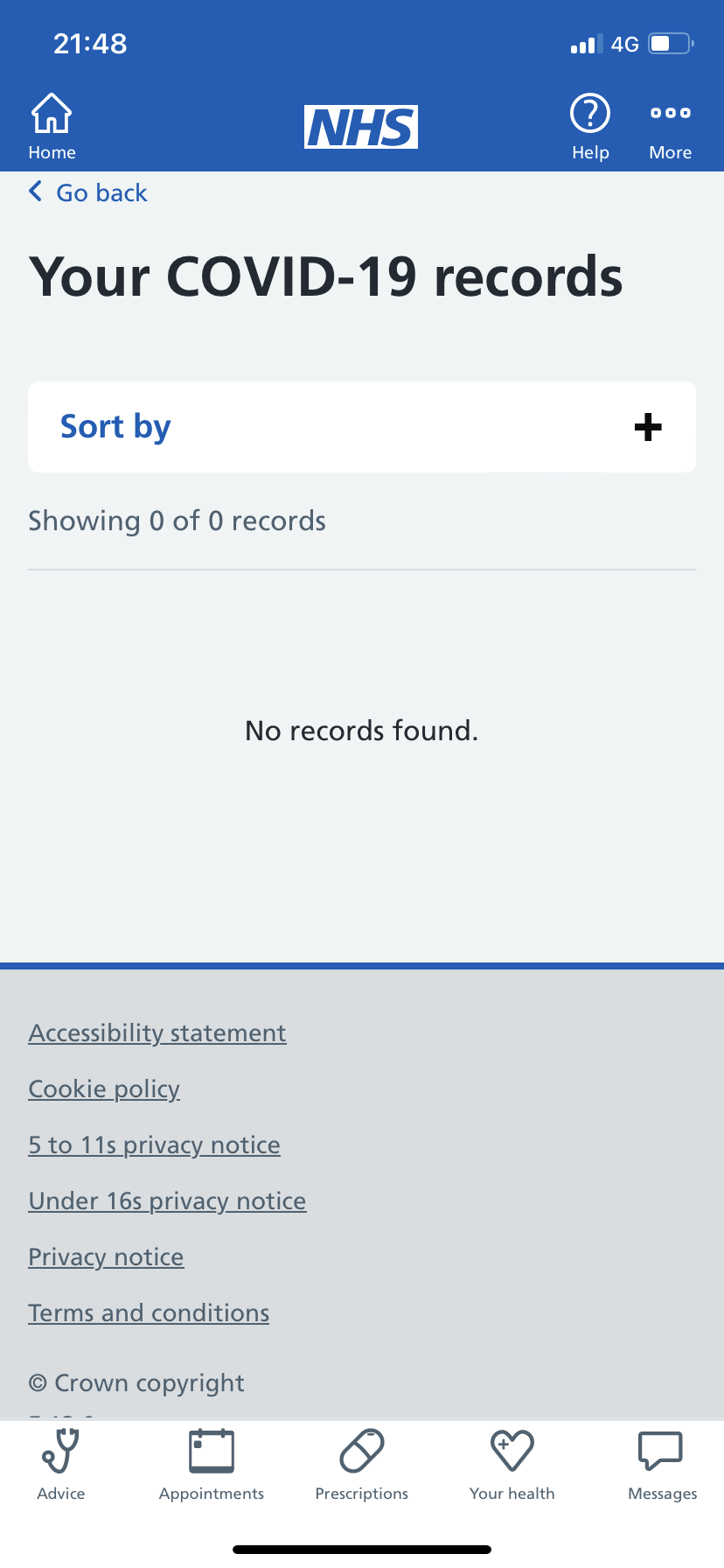
FIG 3
Anti-vaxx is a pejorative term conjured up by the compromised legacy media and the corporate driven pharmaceutical complex to divide and marginalise communities. Whereas the more precise and ethical term for those who did not wish to take an experimental vaccine, with no extant longitudinal data available, is pro-choice. The enforced division of ‘us’ and ‘them’ was further encouraged via a plethora of divisive C-19 media marketing slogans designed to appeal to the heroic altruist which included: I wash my hands to protect my nan; Protect your loved ones; I wear a face covering to protect my mates; I make space to protect you and I wash my hands to protect my family.
The student of moral enterprise cannot but pay particular attention to the role of the mass media in defining and shaping social problems. The media have long operated as agents of moral indignation in their own right: even if they are not self-consciously engaged in crusading or muckraking, their very reporting of certain ‘facts’ can be sufficient to generate concern, anxiety, indignation or panic.
(Cohen, 2002: 9)
Choreopolicing: policing the way we move
I think it will be useful at this point to unpick a term that combines the idea of the police and the choreographer - choreopolicing. I initially developed the concept of choreopolicing based on my reading of a 2013 article ‘Choreopolice and Choreopolitics: or the Task of the Dancer’ by Andre Lepecki: not that you need to read it to understand the basic principle I am sharing. After years of research the idea that we are made to move in particular ways by state-controlled policing, and that this represents a type of dance, it became a useful way of looking at events around me. A way of looking at everyday life. Ever gone to your local supermarket and the layout has changed? It’s not, as most of us know, by chance, but rather a way of guiding/forcing us to take a different route in order to encounter new products: that we didn’t know we needed...nudge nudge wink wink. This simple scenario is a great illustration of choreopolicing.
We are, undoubtedly, choreopoliced in our everyday lives. Here, an analogy can be made with the surveillance mechanisms that increasingly dominate 21st century living. As an example, consider the wider context of societal policing, where surveillance cameras, cell phones, loyalty cards, credit cards, computer-linked location tracking systems, self-checkouts, ULEZ kettling zones (at the time of writing), health trackers, and other devices track our movements. Lepecki says that ‘this condition, where no one is left alone for long, reveals how an apparent freedom of movement is under strict control thanks to constant surveillance’. More glaringly obvious examples can be seen with the blatant attempts by unelected corporate funded entities such as the World Health Organisation (WHO) the International Monetary Fund (IMF) and the World Economic Forum (WEF) to expand the choreopolicing of our everyday lives through the implementation of global digital currency, global digital health passports, digital ID, a pandemic treaty that hands power to the pharmaceutical corporations and other nefarious corporeal control systems. These so called ‘World’ bodies are headed by psychocrats through corporate government partnerships, and all for our own good of course, or so we are told. Gilles Deleuze, in his essay, Postscript On The Societies Of Control, was discussing similar possibilities of control mechanisms as far back as 1992:
The conception of a control mechanism, giving the position of any element within an open environment at any given moment (...) is not necessarily one of science fiction. Felix Guattari has imagined a city where one would be able to leave one's apartment, one's street, one's neighbourhood, thanks to one's (dividual) electronic card that raises a given barrier; but the card could just as easily be rejected on a given day or between certain hours; what matters I snot the barrier but the computer that tracks each person’s position - licit or illicit - and effects a universal modulation.
By following this line of thought I’m asserting that choreopolicing exists in the ‘production’ of our everyday lives. Perhaps the production team(s) behind our nudged lives are inspired by the Truman Show in some way, or regard Orwell as an influencer.
The choreopolicing of minds, language, and movement, was employed extremely effectively via legacy media during C-19. Endogamous corporate-government relationships might explain the effective deployment of narratives during this (and other) period(s).
As an example of these cosy agenda driven relationships we can look at the TNI.
Created in 2019, headed by the BBC, and formed of the worlds most powerful media giants, the oxymoronically named Trusted News Initiative (TNI) employed tactics of ‘divide and rule’ during the lockdown period. As emerging research clearly demonstrates, the TNI used a monopolisation of the truth to suppress voices that conflicted with the myopic narrative that was being forcefully imposed in the lockdown period. “Within the context of any particular regime of truth, the ‘battle’ for truth is conducted in terms of the rules by which the true and false are separated and power is linked and connected to the true.” The rise of the TNI monopoly on truth emerged from the pandemic and continues to be wholly connected and dominated by powerful corporate-governmental interests. As Laura Dodsworth illuminates so clearly in her brilliant book A State Of Fear, ‘the fact is that the response to covid became hyper-partisan’ The TNI continues to try to dominate political and social discourse with their version of ‘the truth’, a truth that is dominated and administrated by corporate interest in the quest for power and profit.
Viral Choreography
C-19 invoked the perfect state of fear for concepts of choreopolicing to be experienced and observed, allowing me to better understand and articulate what the rapidly developing events were (im)posing. Forced lockdowns, curfews, forced masking, public shaming, scapegoating, moral entrepreneurship, marginalisation, digital tracking, emergency powers, nefarious corporate and governmental partnerships, big tech censorship of public discourse, and a host of other worrying practices, attempted to enforce the way in which we moved in society of the virus, and the way in which the viral society moved.
The pandemic became a choreopoliced event that was presented as a huge spectacle twenty-four hours a day via legacy media outlets. The drama was enhanced by the continual presence of death counting clocks live on screen (data provided by Palantir) counting down what was being marketed as the possible end of civilisation: a veritable ticking time-bomb. Investigative journalist Laura Dodsworth refers to these theatrical tactics - along with the early videos emanating from China depicting scenes reminiscent of a Zombie Apocalypse - as ‘stunt covid’. Seeping into our locked down homes, and into our isolated minds and bodies, via a constant barrage of printed and digital media, choreopolicing became more of an explicitly visible force, rather than an implicit notion of governance (as a note, we have seen this attempt at fear mongering for pharmaceutical companies more recently with the Hantavirus theatrics. ) The weekly ‘Clap for Carers’ presented another clear example of choreopolicing at work, invoking the masses of locked down citizens to bang pots and pans on their doorsteps in a show of tribal solidarity and a tribal mentality.
The spectacle, express[es] the total practice of one particular economic and social formation: it is, so to speak, the formation’s agenda.
(Debord, 1994: 15)
As time went on and I investigated what, at first, seemed to be random control and fear tactics, it quickly became clear that many expert voices were being suppressed, private companies were cashing in, and a certain hierarchical structure was in place, as seen on the UK government website: a nonsensical list of who could and who could not travel freely. For instance, nuclear plant workers, MP’s, sports personalities, physiotherapists and fisherman for were amongst those who could travel freely. Whereas I, as a legal across-borders co-parent, could not. They just did not care or have an administrative system in place to support me.
Fear is the foundation of most governments.
(John Adams: founding father and second president of the United States)
I have not had a TV in my house for thirteen years and perhaps that allowed me to escape the constant advertising of fear that was creating panic and turbulence amongst the general public. Researching a little deeper, as was my instinct, and going against the C-19 orthodoxy at the time, I found that the UK C-19 advertising (the fear) campaigns were being led by behavioural psychologists. At the helm of the UK behavioural change team was Susan Michie at UCL, who headed SAGE and advised alternative SAGE: I became aware that a conflict of interests might be at play here, and her online celebration of the Chinese response to C-19, along with her membership of the communist party added to my concerns. The draconian lockdown control measures were accompanied by ridiculously over-acted (Can You Look Them In The Eye) over produced and melodramatic messages, carried by the ‘advertising the fear’ campaigns. These propaganda spectacles were being produced by the likes of M & C Saatchi and MullenLowe Global (Fig:4). The advertising bill was running at £500,000,000 and rising. Additionally, government units such the 77th Regiment - the online surveillance unit attached to the British Army - were policing any voices that questioned the preferred narrative. Adding to these conflicts of interest was the fact that the only epidemiologist who was given a voice in the legacy media was Neil Ferguson (Imperial College London) whose doom laden calculations lacked any scientific basis and who had a record of grossly miscalculating deaths in relation to previous viral outbreaks. Fergusons work was funded to the amount of $80 million from the Bill and Melinda Gates foundation, which is closely linked to Big Pharma and the promotion of vaccines. My research raised more questions and anxieties than answers, and I wanted to know more: as discussed in Engelbrecht’s 2021 book Virus Mania.